

Cardio Pilates Reformer: Jumpboard and Conditioning

A reformer jumpboard provides an intense cardiovascular workout without joint impact by using horizontal spring resistance instead of hard ground impact. Pushing off the padded board while lying supine on the moving carriage increases your heart rate, builds reactive lower body power, and demands continuous abdominal stabilization. Integrating dynamic props like plank bars and TRX suspension straps turns a traditional reformer session into a complete full-body conditioning system.
Getting the heart rate up during Pilates reformer classes adds another fun element to reformer workouts and boosts the calorie burn during classes. While classical reformer sequences emphasize deliberate joint articulation and sustained spring resistance, incorporating cardio intervals challenges the cardiovascular system while protecting delicate connective tissue. Class participants experience the stamina benefits of athletic cross-training alongside the mindful precision of traditional Pilates movement.
How Does the Pilates Reformer Jumpboard Work?
The jumpboard is a padded large board that is inserted into the footbar end of the reformer, allowing class participants to propel themselves off the board in a wide variety of body positions. You can jump while lying supine on your back, on your side, on hands and knees, or even prone over a long box for very low weight jumping with hands. The carriage glides smoothly along the aluminum rails, supporting your body weight so your feet press away against calibrated spring resistance.
Using a jumpboard on a Pilates reformer provides a low-impact cardiovascular workout while building lower body power, core stability, and bone density. Because gravity acts horizontally across the body rather than vertically through the spine, individuals can perform explosive plyometric intervals without the jarring joint compression associated with running on pavement.
Why Supine Jumpboard Movements Protect the Body
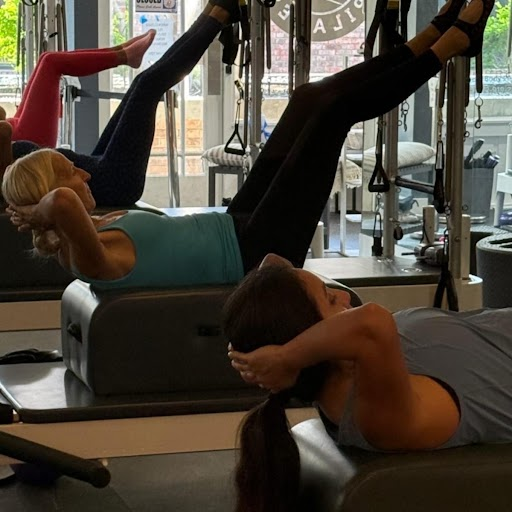
When using the jumpboard in a supine position on your back, the headrest is in a lifted position to help protect the neck from the more ballistic movements. This slight incline supports optimal neutral alignment through the cervical spine and upper back, preventing tension from accumulating in the shoulders during rapid push-off repetitions.
Spring loads can vary depending upon the goal of the movement being performed during class:
Higher spring loads focus more on strengthening the large leg muscles, including the quadriceps, hamstrings, and glutes.
Lower spring loads focus more on the abdominals and deep pelvic stability, requiring the core to control the lighter, faster carriage return.
Regardless of spring load, supine jumping requires a lot of abdominal work to prevent the legs from plummeting below the height of the top of the jumpboard. A wide variety of choreographic movements and paces of movement can be performed supine, including double or single leg jumping, jumping with props, and jumping Hundreds to increase cardiovascular output. Another component that can be added to supine jumping is the tower push-through bar, where participants jump, grab the bar, suspend for a moment, and repeat, or use the push-through bar for supine pull-ups designed to raise the heart rate.
Key Benefits of Pilates Reformer Jumpboard Training

The primary prop for adding the cardio component to Pilates reformer workouts is the jumpboard, which combines athletic conditioning with rehabilitative joint safety. Jumping horizontally on the reformer delivers distinct physical advantages:
Low-Impact Cardio: The reformer springs cushion your landing. This protects your knees, hips, and ankles while still raising your heart rate like running or skipping rope.
Plyometric Strength: Pushing off the board uses a natural load and rebound action. This trains fast-twitch muscle fibers to produce force quickly without heavy ground impact.
Deep Core Engagement: Your abdominal muscles must stay tight and engaged to stabilize your torso during every push and responsive landing.
Bone Health: The controlled, weight-bearing jumping movement applies healthy force to the skeleton. This helps stimulate bone-forming cells and improve bone density.
Lower Body Toning: The repetitive pressing motion targets and sculpts your quads, hamstrings, calves, and glutes through full ranges of motion.
Better Balance and Coordination: The fast, rhythmic timing required to jump and land accurately improves your spatial awareness, reflexes, and joint stability.
Expanding Range of Motion with Plank Bars and Upper Body Work
The plank bars can be used in various positions, and using plank bars allows longer duration and bigger ranges of movements. Using the plank bars in a prone position on top of a box allows hand jumping on light springs to be performed with far less risk than using a jumpboard for upper body ballistic work.
Even without ballistic jumping, using plank bars can keep the heart rate up with planks, push-ups, JackRabbit variations, and tricep dips, exercising greater ranges of movement. These sequences recruit upper body muscles in ways not available with standard Pilates reformer movements alone. Smaller muscle groups go to failure faster than the larger leg and glute muscles, so alternating between jumping intervals and plank bar drills creates a balanced conditioning stimulus across the entire physique.
Integrating TRX Suspension for Full-Body Standing Power
Adding TRX for upper body movements and squats or lunges adds a standing component to Pilates classes. TRX is not a piece of traditional Pilates equipment, but it complements Pilates with its core-based movements and functional body-weight positioning.
The degree of difficulty using TRX is dependent upon proximity to the anchor point, so class participants can adjust difficulty easily by moving closer to or further away from the anchor point. Stepping closer to the anchor increases the percentage of body weight you must support, while stepping backward offers greater stability for recovery intervals.
What to Expect in Toned Body Pilates in Stuart, Florida Jump Circuit Classes
In our dedicated Pilates Jump Circuit sessions in Stuart, FL, we bring these versatile tools together into an integrated group routine. Classes utilize our studio Balanced Body Allegro II reformers with towers to cycle through jumpboard intervals, upper body reformer strength work, and standing TRX sequences.
Every workout balances high-energy cardio bursts with the mindful alignment and postural control foundational to our contemporary teaching method. Because our equipment adapts instantly to individual mechanics, students across Martin County experience a challenging conditioning workout tailored to their exact fitness level.
Join the Movement at Toned Body Pilates
Integrating jumpboard intervals, plank bar variations, and functional TRX exercises into your routine transforms reformer Pilates into a comprehensive cardiovascular and core workout. By blending low-impact spring resistance with athletic plyometrics, you build lean muscle tone, improve reactive balance, and boost heart health while safeguarding your joints.
Toned Body Pilates provides contemporary reformer instruction on top-tier Balanced Body Allegro II equipment in Stuart, Florida. Whether you are seeking joint-safe cardio conditioning or deep core stability, our supportive community and expert instructors guide you every step of the way. To begin your journey, explore our class descriptions, review our studio policies, check our membership pricing, or contact us today to schedule your private orientation session.
Frequently Asked Questions
Do I need prior reformer experience to attend a Pilates Jump Circuit class?
No. Participants should have attended a few reformer classes before joining a Basics-level jumpboard class.
What should I wear to a Pilates jumpboard class?
Comfortable, form-fitting athletic wear allows instructors to observe your spinal alignment and joint tracking throughout rapid movements. Grip socks are required in all classes for safety and stability on the carriage and are available for purchase at the studio.
Can I participate in jumpboard classes if I have knee or joint sensitivities?
The horizontal positioning on the reformer removes gravitational pressure from the lower joints, making the jumpboard an exceptional choice for low-impact cardio. Clients should always inform the instructor of preexisting orthopedic conditions so spring tension and foot placement can be adjusted.
How does reformer jumpboard training improve bone density?
The controlled, weight-bearing jumping movement applies healthy mechanical force to the skeleton without joint impact. This safe resistance stimulates bone-forming cells and helps build mineral density through the hips, spine, and lower extremities.


Comments